Online Presence
Why Your Business Needs an Online Presence
Arguing that a business needs to exist online is no longer an argument anyone needs to win. What is still worth saying is more specific: which parts of an online presence actually earn their keep,…
In short
Paid traffic magnifies whatever is already there, including the gaps — so a weak site wastes the advertising rather than merely underperforming. What matters is being findable for your own name, proof a sceptical person can verify, speed on a real phone, one clear next step, and claims that agree across every property you own.
Arguing that a business needs to exist online is no longer an argument anyone needs to win. What is still worth saying is more specific: which parts of an online presence actually earn their keep, and which parts are decoration that quietly costs you money.
This matters most if you are about to advertise. Paid traffic magnifies whatever is already there — including the gaps.
1. People check you before they contact you
Almost nobody enquires with a supplier they have not looked up first. They search your name, they read whatever comes back, and they decide whether to bother.
That check happens whether or not you have anything to show them. An absent or thin presence does not read as neutral; it reads as a reason to try someone else.
2. Advertising into a weak site wastes the advertising
This is the practical one. Paid search buys attention, and the site decides whether that attention converts. If the page is slow, unclear, or answers a different question than the ad promised, you have paid full price for a poor first impression.
Every rupee of media spend is multiplied by whatever conversion rate the site achieves. Improving the site improves the return on all of it at once, which is why fixing the destination usually beats optimising the campaign.
3. You control it, and you do not control the platforms
A profile on someone else's platform is rented. The rules change, reach declines, accounts get suspended by automated systems with no meaningful appeal.
Your own site, your own domain, your own email list are the assets you keep. Everything else should point back at them. This is why a business with a large social following and no owned presence is more fragile than it looks.
4. Being findable for your own name is the minimum
Before any campaign, check what a search for your business name returns. If it returns a competitor's advert, an outdated directory listing, or nothing coherent, that is the first thing to fix — it is the cheapest search you will ever win and the one every prospect performs.
5. Local presence decides local enquiries
For anyone serving a defined area, a properly completed and maintained business profile — correct address, hours, categories, photographs, responses to reviews — drives a meaningful share of enquiries on its own, and supports paid campaigns targeting the same area.
It costs nothing but attention, and it is neglected constantly.
6. Proof is the part that converts
The section of a website that changes minds is rarely the copy about how passionate the team is. It is the evidence: named clients where permission exists, figures with a source, credentials that can be verified, testimonials from identifiable people.
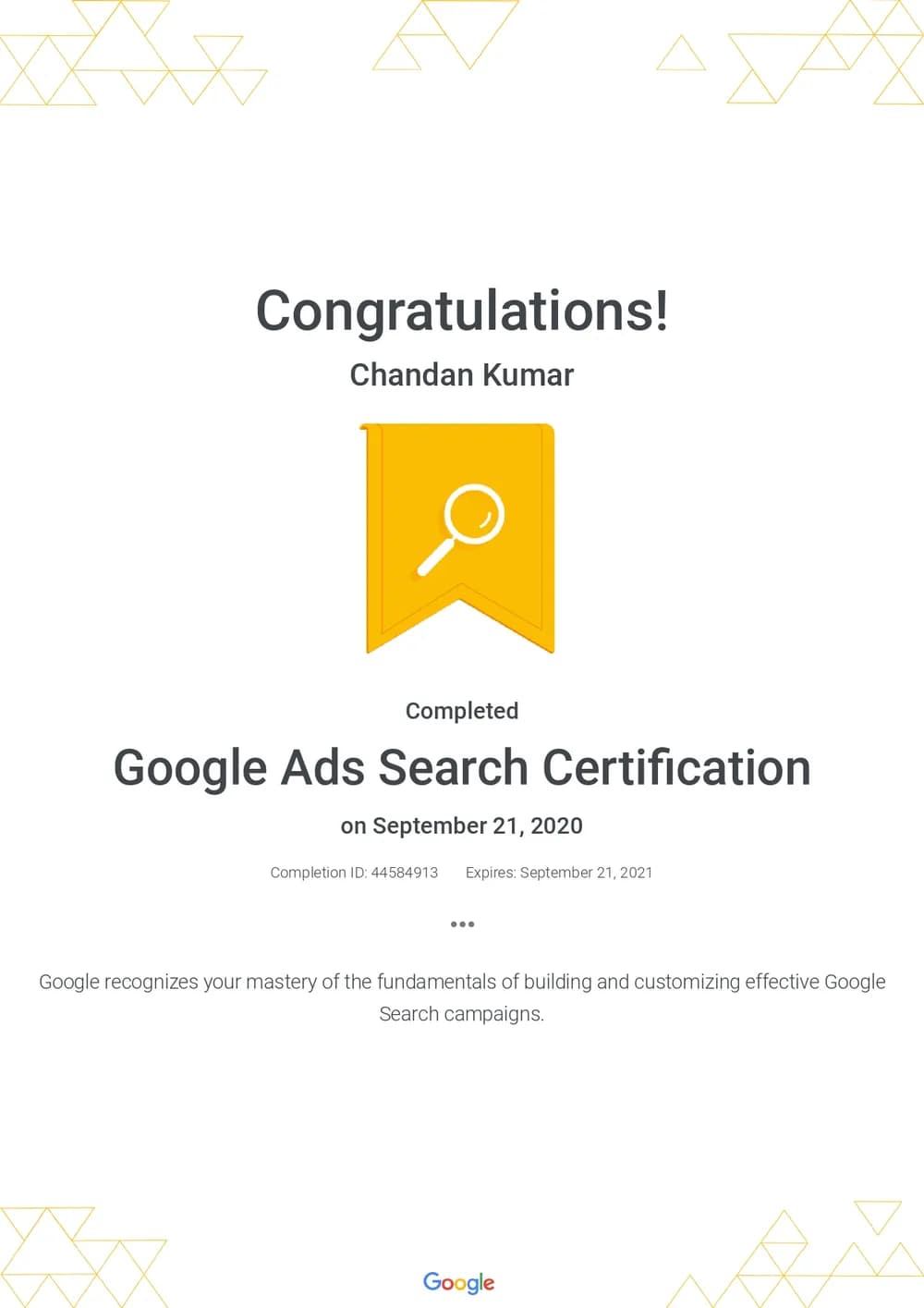
Anything unverifiable is worse than absent, because the buyers worth having are precisely the ones who check. This is the principle the whole of this site is built on — case studies traced to their published sources, certifications listed with completion IDs.
7. Speed is a business metric, not a technical one
Most paid traffic arrives on a phone, often on a mobile connection. A page that takes several seconds to become usable loses a substantial proportion of visitors before they read a word, and you have already paid for every one of them.
Test on an actual phone on mobile data rather than on office broadband. The difference is frequently uncomfortable.
8. One clear next step beats five
Sites that offer a visitor a dozen possible actions convert worse than sites that offer one obvious one. Decide the single thing you want a visitor to do on each page, make it visible without scrolling, and repeat it further down.
Where the enquiry method matters, use what your market actually uses. In much of the Indian SME market a WhatsApp thread gets started when a contact form would have been abandoned.
9. Content builds the ground that advertising rents
Advertising stops the day you stop paying. Published material that answers real questions keeps working, gets cited, and increasingly gets summarised by AI systems answering questions on your behalf.
The two are complements. Advertising captures the demand that exists today; published expertise is what makes someone choose you rather than a cheaper competitor once they arrive.
10. Consistency across properties is a credibility test
If your website says one thing, your business profile another, and your social bios a third — different founding years, different experience claims, different service lists — anyone comparing them concludes you are careless.
It also confuses the systems that decide which results to show. Search engines and language models are trying to resolve who you are from every source they can find, and contradictions across properties you own are the most damaging kind, because you are the only person who could have prevented them.
Before you spend on ads
A short checklist. If any of these fails, fix it before increasing media spend:
- Searching your business name returns you, correctly, above the fold.
- Your main service page loads quickly on a phone on mobile data.
- A visitor can tell within a few seconds what you do and who for.
- There is one obvious next step, and it works — test the form yourself and confirm the message arrives.
- There is at least one piece of proof a sceptical person could verify.
- The claims on your site, your business profile and your social accounts agree with each other.
None of that is expensive. All of it multiplies whatever you spend afterwards, which is why it comes first — and why an agency that wants to start spending your budget without checking any of it is not doing you a favour.
Frequently asked
Do I still need a website if I am active on social media?
Yes. A profile on someone else's platform is rented — rules change, reach declines, and accounts get suspended by automated systems with no meaningful appeal. Your own site, domain and email list are the assets you keep. A business with a large following and no owned presence is more fragile than it looks.
What should I fix before increasing ad spend?
Six things: that searching your business name returns you correctly; that your main service page loads quickly on a phone on mobile data; that a visitor can tell within seconds what you do and for whom; that there is one obvious next step and it actually works when tested; that there is at least one piece of proof a sceptic could verify; and that your claims agree across every property you own.
How fast should my website load?
Fast enough that it does not lose the traffic you paid for — and the test that matters is an actual phone on mobile data, not office broadband. Most paid traffic arrives on a mobile connection, and a page that takes several seconds to become usable loses a substantial share of visitors before they read a word.
Why does consistency across my online profiles matter?
Because contradictions between properties you own are the most damaging kind — you are the only person who could have prevented them. Different founding years or experience claims across your website, business profile and social bios tell anyone comparing them that you are careless, and they confuse the search engines and language models trying to resolve who you are.
- Strategy
- Website
- Local SEO
- Conversion
Next step
Score your account
Twenty questions across tracking, structure, landing pages and bidding. You get a score and a prioritised list of what to fix first.