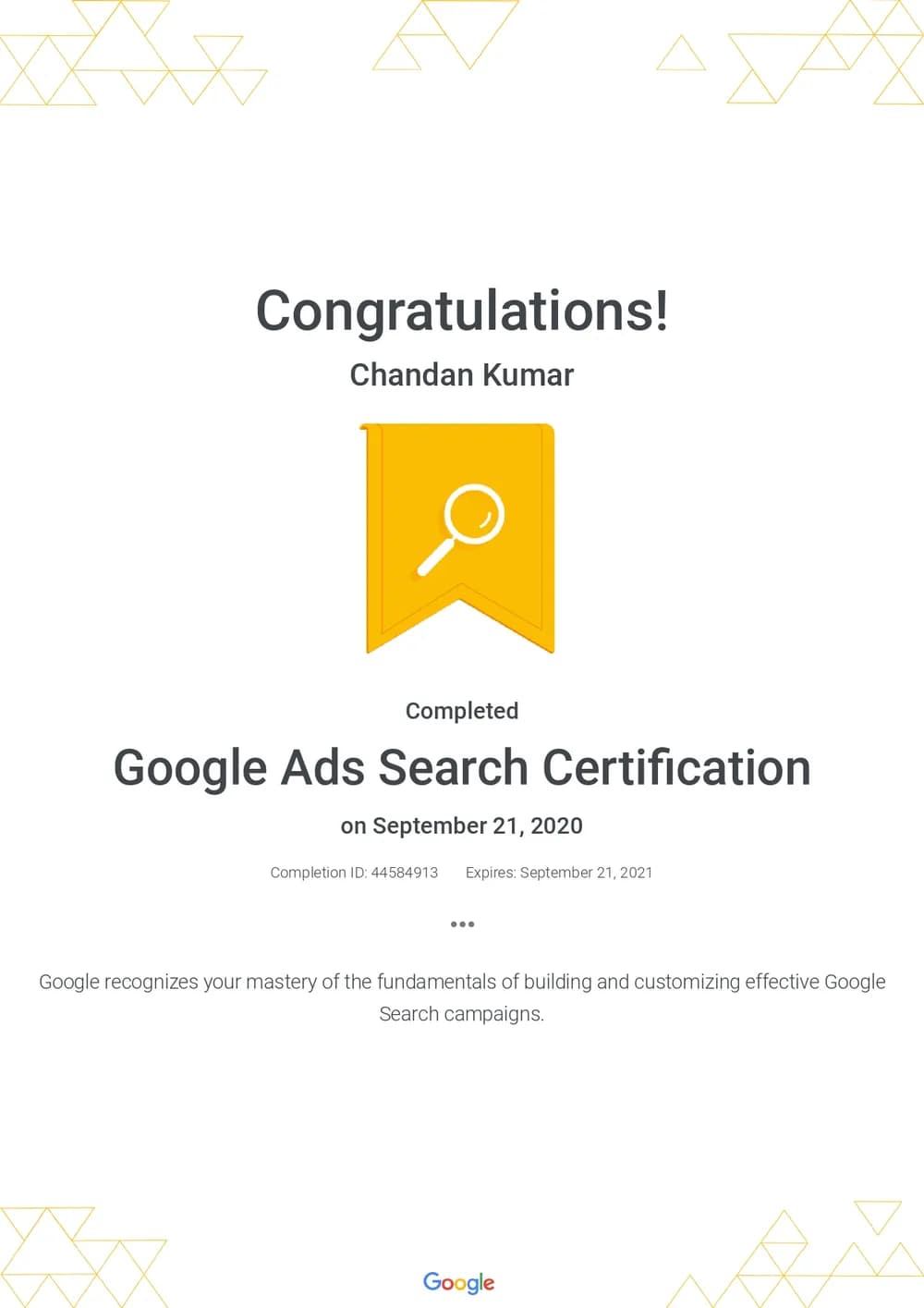
Google Ads
Google Ads Basics: What to Get Right Before You Spend
Most people set up their first Google Ads campaign in about twenty minutes, and most of those campaigns waste money for months before anyone works out why. The platform is deliberately easy to start…
In short
Set up conversion tracking before you spend anything — automated bidding optimises towards whatever you report, so reporting the wrong action teaches it to buy the wrong traffic. Start on Search with tight keywords and a negative list already in place, send each ad group to a page that answers its search, and judge the account on cost per acquired customer rather than click-through rate.
Most people set up their first Google Ads campaign in about twenty minutes, and most of those campaigns waste money for months before anyone works out why. The platform is deliberately easy to start and genuinely hard to run well, and the gap between those two things is where budgets disappear.
This is what actually matters when you begin, in the order it matters.
Measurement comes before spending
The single most common fault in a new account is that nobody can tell which clicks turned into business. Without that, every later decision — which keyword to pause, which ad to keep, what to bid — is guesswork dressed up as optimisation.
So before the first ad goes live, decide what counts as a conversion. Not a page view. Not time on site. The action that means a real person is worth talking to: a form submission, a booked call, a purchase, a phone call over a set duration.
Then set up conversion tracking and check it fires once, on the right action, and reports back into Google Ads. Test it yourself. Submit the form and confirm the conversion appears in the interface — it can take a few hours, so do this before you need the data, not after.
Bidding depends entirely on this. Google's automated strategies optimise towards the conversions you report. Report the wrong thing and the system will get very good at buying you the wrong thing. That is worth its own read: conversion tracking that reconciles with reality.
What you are actually bidding on
Google Ads is an auction, but not a straight one. You do not win position by paying the most. Each time someone searches, Google combines your bid with a quality assessment of your ad and landing page, and ranks the result. This is why a well-built account can pay less per click than a careless competitor bidding higher.
The practical consequence: relevance is not a soft virtue, it is a discount. An ad that closely answers the search, pointing at a page that delivers what the ad promised, costs less and converts better at the same time.
Quality Score is the diagnostic Google exposes for this, scored 1–10 across expected click-through rate, ad relevance and landing page experience. Treat it as a symptom reader rather than a target. A low score tells you where to look; chasing the number itself is a distraction.
Keywords and match types
A keyword is not a search. It is an instruction about which searches you are willing to pay for, and match type sets how loosely Google may interpret it.
- Exact match
[running shoes]— that search and close variants of it. - Phrase match
"running shoes"— searches that include that meaning, with words either side. - Broad match
running shoes— anything Google judges related, which can be very loose indeed.
Broad match gets recommended constantly because it spends the budget. It can work, but only when conversion tracking is solid and the account has enough conversion data for the system to learn from. Starting broad on a new account with no data is the reliable way to fund a lot of irrelevant clicks.
Start tighter than feels comfortable. Read the search terms report weekly — it shows what people actually typed — and expand deliberately from what you see there.
Negative keywords are not optional
Every account needs a list of searches it refuses to pay for. Job hunters, students, people looking for free versions, people researching salaries, people in the wrong country. None of them will ever buy, and all of them will click.
Build the list before launch and add to it every time you read the search terms report. For business-to-business accounts, this starter list of negative keywords covers the categories that waste money in almost every account.
Choosing a campaign type
Each campaign type answers a different question, and mixing them up is a common and expensive error.
Search captures existing demand. Someone is looking for what you sell, right now. It is the highest-intent inventory Google has and the right starting point for almost every business with a defined product or service.
Performance Max runs across Search, Display, YouTube, Gmail, Discover and Maps from one campaign, with Google deciding the split. It can perform well, but it gives you less visibility and control than Search, and it will happily absorb budget that a Search campaign would have spent better. It is not a first campaign.
Display puts banners on websites across Google's network. Cheap clicks, low intent. Useful for remarketing to people who have already visited; poor as a source of new demand for most businesses.
Video runs on YouTube, and works for demand you are creating rather than capturing.
Shopping is for retailers, and the product feed does most of the work — feed quality matters more than bids. Both video and Shopping are covered properly in the Shopping and video guide.
Demand Gen and App campaigns serve narrower purposes; ignore them until the basics are earning.
If you only run one thing: run Search, on tight keywords, with good tracking.
Account structure
Structure exists to give you control and readable data, not to satisfy a rule. The old advice to build tiny single-keyword ad groups came from an era when you controlled matching far more precisely than you do now. It is mostly obsolete.
What still holds: group keywords that share an intent, so one ad can honestly speak to all of them and one landing page can answer all of them. If you find yourself writing an ad that has to hedge between two different needs, the ad group is doing too much. Split it.
Keep campaigns separate where you need separate budgets, separate locations, or separate reporting. Budget lives at campaign level, so if you cannot control the spend on something independently, it needs its own campaign. There is more on this in the account structure guide.
Ads that match the search
Responsive search ads take multiple headlines and descriptions and assemble them per auction. You supply the parts; Google chooses the combination.
The discipline that matters is message match. If someone searches for a specific service in a specific city, the ad should name that service and that city, and the landing page should open with it. Every step where the wording drifts loses people.
Write headlines that say what the thing is, who it is for, and what makes it different in a way a competitor could not simply copy. Avoid the empty superlatives — "best", "leading", "world-class" — which cost you space and persuade nobody.
Use the asset types that fit: sitelinks to other relevant pages, callouts for genuine differentiators, structured snippets for lists, call assets if phone enquiries matter. They cost nothing extra, take more of the results page, and give people more ways to find the right thing.
Landing pages
The fastest way to waste a good campaign is to send the traffic to your homepage. A homepage is designed to serve everybody, which means it answers nobody's specific search.
Send each ad group to a page that answers its search directly, loads quickly on a phone, and makes the next step obvious. One primary action, visible without scrolling, repeated further down. The landing pages guide covers the order to fix things in.
Budget and bidding
Set the daily budget you can genuinely sustain for long enough to learn something. Google may spend up to twice your daily budget on a given day, balancing over the month, so treat the daily figure as an average rather than a cap.
On bidding: start with a strategy that does not require conversion data you do not yet have. Once conversions are recorded reliably and there is a reasonable volume of them, automated strategies such as Maximise Conversions or Target CPA generally beat manual bidding, because they adjust per auction using signals you cannot see.
The important constraint is data. Smart bidding needs conversions to learn from — a campaign generating a handful a month will not give the system enough to work with, and the results will look erratic. If you are nowhere near that, the answer is usually a wider campaign or a cheaper conversion action further up the funnel, not a cleverer bid strategy. You can work the numbers backwards with the budget planner.
What to do in the first month
The first month
What to actually do, in order
Measurement before spending, structure before optimisation, and one change at a time so the result means something.
Confirm conversion tracking works, end to end
Submit the form yourself and check exactly one conversion lands against the right action. Do this before launch, not after.
Launch one Search campaign, tightly themed
With the negative keyword list already in place, not added later.
Read the search terms report weekly
Add the junk as negatives. Add the good terms as keywords in their own right.
Change one thing at a time
And leave each change running long enough to accumulate conversions, not clicks.
Judge it on cost per acquired customer
Not click-through rate. An account can improve every diagnostic and produce fewer customers.
That last point is the one that separates accounts that work from accounts that look busy. Impressions, clicks and click-through rate are diagnostics. The only number that pays anyone's wages is what it costs to acquire a customer, set against what that customer is worth.
If you have an account running already and want a structured read on what is weakest, the Google Ads scorecard walks the same ground in twenty questions.
Frequently asked
How much do I need to spend on Google Ads to start?
Enough to produce a steady flow of conversions, because that is what both you and Google's bidding need to learn from. A budget that yields only a handful of conversions a month cannot be optimised meaningfully by anyone. If your budget is that thin, narrow the target — fewer keywords, a smaller area, a cheaper conversion action — rather than spreading the same money across more ground.
Should a beginner start with Performance Max?
No. Performance Max spans Search, Display, YouTube, Gmail, Discover and Maps with Google deciding the split, which means less visibility and less control at exactly the point when you most need both. It also relies on conversion data that a new account does not yet have. Start with a Search campaign on tight keywords, get tracking right, then consider it.
How long does it take for conversion tracking to show data?
Conversions can take several hours to appear in the Google Ads interface. Test the setup before you need the data rather than after — submit the form yourself, then check that exactly one conversion appears against the right action. Tracking that fires twice, or on the wrong event, will quietly distort every decision that follows.
What is a good Quality Score?
Treat it as a diagnostic rather than a target. Quality Score is scored 1–10 from expected click-through rate, ad relevance and landing page experience, and a low score usually points at a mismatch between what people searched for and what your page delivers. Fix the mismatch; the number follows. Chasing the number directly is wasted effort.
- Google Ads
- PPC
- Conversion Tracking
- Campaign Setup
Next step
Score your account
Twenty questions across tracking, structure, landing pages and bidding. You get a score and a prioritised list of what to fix first.